
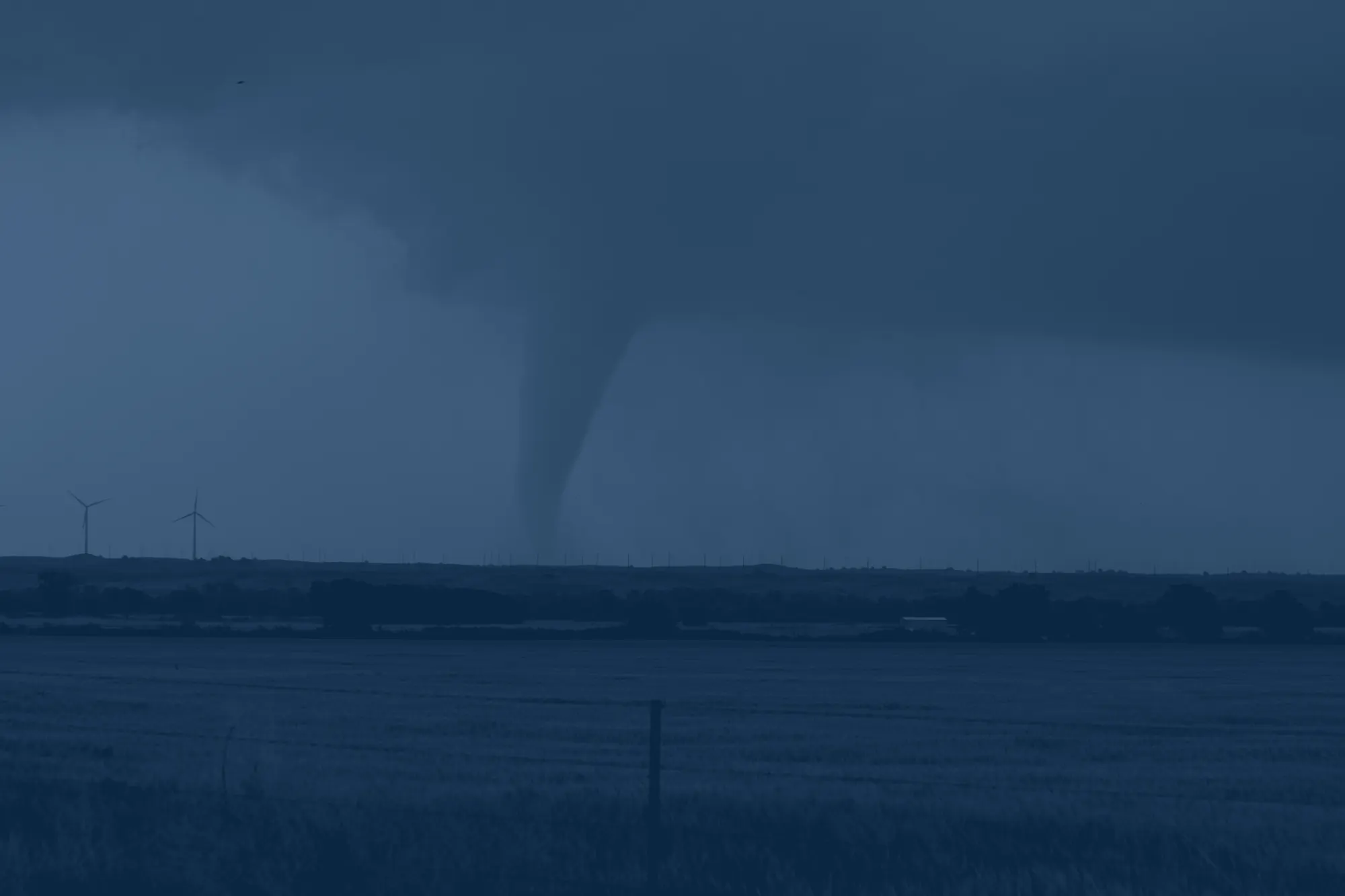
How tornadoes are rated
The United States rates tornadoes on the Enhanced Fujita, or EF, scale, an update of the original Fujita scale by meteorologists and wind engineers that took effect on February 1, 2007. Its winds are estimates, not measurements: surveyors judge which of 8 degrees of damage occurred to any of 28 damage indicators, from one- or two-family homes and mobile homes to trees, and convert that to a three-second gust.1
| Rating | Estimated three-second gust |
|---|---|
| EF0 | 65 to 85 mph1 |
| EF1 | 86 to 110 mph |
| EF2 | 111 to 135 mph |
| EF3 | 136 to 165 mph |
| EF4 | 166 to 200 mph |
| EF5 | over 200 mph |
The Storm Prediction Center warns that these estimates vary with height and exposure, and that the three-second gust is not the same wind that standard weather stations report.1 The original Fujita scale became the backbone of a national tornado database that holds a record of every U.S. tornado since 1950.2
T. Theodore Fujita introduced that scale in a research paper in February 1971. The Storm Prediction Center traces the move to the enhanced version to two Plains tornadoes, at Jarrell, Texas on May 27, 1997 and at Oklahoma City and Moore on May 3, 1999, which raised the concern that the old scale's wind estimates were too high for the damage seen.2
How often and where tornadoes are recorded
The Storm Prediction Center puts recent U.S. tornado counts at around 1,200 a year, give or take a few hundred, and says the true long-term average is unknown because the ways tornadoes are spotted and reported have changed a great deal.3 Reports rose sharply in the 1990s as the National Weather Service installed its Doppler radar network.2 Most tornadoes last less than 10 minutes, and the average path since 1950 is about 3.5 miles long.3
FEMA notes that most of the roughly 1,250 tornadoes reported each year are rated EF0 to EF2, and that tornadoes, especially those weaker ones, occur throughout the region east of the Continental Divide, not only in the central and southeast states.4 Timing shifts with latitude. Peak season in the southern Plains runs from May into early June, the Gulf Coast peaks earlier in spring, and the northern Plains and upper Midwest peak in June or July, though tornadoes can happen in any month.3
The records sit in NOAA's Storm Data publication and in the Storm Prediction Center's downloadable files, and NOAA's online Storm Events Database can be searched by state and county. That database lists tornadoes by county segment, not as whole tracks, and it still contains some coding errors.3
Hail sizes and what they do
The National Weather Service calls a thunderstorm severe when it brings a tornado, hail at least 1 inch across, or winds of 58 mph or more. A severe thunderstorm warning goes out when radar or a spotter shows such a storm and usually runs for an hour, while the Storm Prediction Center issues severe thunderstorm watches, usually for 4 to 8 hours, when conditions favor them.5 NSSL notes that hail can wreck cars, homes and even aircraft, and can kill livestock and people.6 Observers estimate hail size by comparing stones with familiar objects, though NOAA's National Severe Storms Laboratory says a ruler or calipers give the best measurement.6
| Comparison object | Diameter |
|---|---|
| Pea | 1/4 inch6 |
| Penny | 3/4 inch |
| Quarter, the severe threshold | 1 inch |
| Ping-pong ball | 1 1/2 inches |
| Golf ball | 1 3/4 inches |
| Tennis ball | 2 1/2 inches |
| Baseball | 2 3/4 inches |
| Softball | 4 inches |
NSSL's figures show why size matters. Stones of 1 to 1.75 inches, typical of a severe storm, are expected to fall at 25 to 40 mph, stones of 2 to 4 inches at 44 to 72 mph, and stones larger than 4 inches can top 100 mph. Wind-driven hail can tear siding, break windows and blow into houses. The largest U.S. hailstone on record, 8 inches across, came down on June 23, 2010, in Vivian, South Dakota.6
Hail falls in swaths that range from a few acres to 10 miles wide and 100 miles long. Florida has the most thunderstorms, but hailstorms are usually most frequent in Nebraska, Colorado and Wyoming, and the corner where they meet averages seven to nine hail days a year.6
Roofs and impact ratings
A roof label is not the whole story. IBHS, the Insurance Institute for Business & Home Safety, tests impact-resistant asphalt shingles bought from retail stores, hits them with impacts meant to mimic natural hail, and scores damage from granule loss and dents to cracks and fully broken shingles; its finding is that "not all impact-resistant shingles perform the same when hail strikes."7 IBHS also suggests pairing impact-rated shingles with a FORTIFIED Roof built with a hail supplement.7 Its hail lab and field teams also study how aging changes a roof's performance from one climate to another.8
- What is the roof covering, when was it installed, and is there a permit?
- Does the product carry an impact rating, and does IBHS list a performance score for it?
- Has the roof had hail claims or repairs, and were they inspected afterward?
- How does the policy pay for a damaged roof, at replacement cost or at a depreciated value, and does it exclude cosmetic damage?
Damaging wind from thunderstorms
Thunderstorms also do damage without a tornado. FEMA's National Risk Index treats that as its own hazard, strong wind, defined as damaging winds, often from thunderstorms, classified as exceeding 58 mph.9 FEMA's guidance for one- and two-family homes says that higher-rated envelope materials, opening protection and a stronger load path and connections reduce the common types of tornado damage for storms rated EF2 or weaker, and help in severe thunderstorms and derechos as well.4
FEMA illustrates the problem with damage it documented in Dawson Springs, Kentucky in December 2021: failed load paths, stripped roof shingles, soffits and siding, and broken windows. Its recommendations apply to new construction and to retrofits of existing homes in tornado-prone regions.4 FEMA also reports seeing more damage to homes in tornado-prone areas where building codes are seldom adopted or enforced.4
- Which code edition applied when the house was permitted, and was it enforced locally?
- Are the roof, walls and foundation tied together with straps, clips or anchors?
- Are windows and entry doors protected, and is the garage door rated for wind pressure?
How FEMA rates tornado, hail and wind
The National Risk Index rates tornado, hail and strong wind for every census tract, using events from 1986 through 2023 for all three in its December 2025 data.10 Since 2021 it has modeled tornadoes in three groups by EF rating, EF0 and EF1, EF2 and EF3, and EF4 and EF5, with damage areas sized to each group. FEMA says that change cut modeled tornado risk in densely populated counties that seldom see severe tornadoes, especially in the Northeast and around the Great Lakes.10 The guide to the National Risk Index covers how its ratings and scores work.
Among the sample tracts, the Gatlinburg Welcome Center's rates Relatively Moderate for both tornado, at a score of 61.8, and strong wind, at 69.1. The Biloxi Visitors Center tract rates Relatively Moderate for tornado at 58.0, and Jennette's Pier rates Relatively Moderate for strong wind at 73.3 and tornado at 69.6. Hail does not reach Relatively Moderate in any of the nine sample tracts, and the Fort Myers Beach tract's hail rating is Very Low (see the Gatlinburg sample).
Wind and hail deductibles
Many homeowners policies set a separate deductible for wind or hail, figured as a share of the dwelling limit. The Texas Department of Insurance wrote in September 2024 that a common amount is 2 percent for wind or hail and 1 percent for other damage, and it points owners to the declarations page, which lists the dollar amount of each deductible.11 As an illustration, 2 percent of $300,000 in dwelling coverage is $6,000 out of pocket per claim. The deductible guide works through the rules and the math, and a licensed agent can say what applies in your state.
Tornado and hail figures in an Avantosa report
The tornado and hail picture in a report comes from two places. The National Risk Index table gives the tract's tornado, hail and strong wind ratings and scores beside the other 15 hazards, and the declarations section counts the federal declarations that included the county, sorted by incident type.10 Sevier County, Tennessee shows how severe weather appears there: its list includes a 2025 emergency declaration, EM-3625-TN, that covered straight-line winds and tornadoes along with severe storms and flooding. The report does not map hail strikes or tornado paths at the address itself.
See how those ratings read on the Gatlinburg Welcome Center sample, then use the order page to request the same check for a property on your list.
Tornado and hail questions from buyers
What does an EF2 tornado rating mean?
What size hail can damage a roof?
Where does hail fall most often in the United States?
How many tornadoes hit the United States each year?
Recent counts run around 1,200 a year, give or take a few hundred, by the Storm Prediction Center's estimate, which adds that the true average is unknown because reporting has changed over the decades.3
What is a wind and hail deductible?
It is a separate deductible for wind or hail claims, usually set as a share of the dwelling limit; Texas regulators cite 2 percent as common.11 Check the dollar figure on the declarations page before you buy the policy.
Sources
- Enhanced F Scale for Tornado Damage, Storm Prediction Center, read 2026-11-27.
- The Enhanced Fujita Scale: history and background, Storm Prediction Center, read 2026-11-27.
- The Online Tornado FAQ, Storm Prediction Center (last modified August 1, 2026), read 2026-11-27.
- Improving Windstorm and Tornado Resilience: Recommendations for One- and Two-Family Residential Structures, FEMA fact sheet, February 2023 (PDF), read 2026-11-27.
- Glossary entries for severe thunderstorm, watch and warning, National Weather Service, read 2026-11-27.
- Severe Weather 101: Hail Basics, NOAA National Severe Storms Laboratory, read 2026-11-27.
- Hail impact-resistant shingle ratings and test method, IBHS, read 2026-11-27.
- Hail research overview, IBHS Research Center, read 2026-11-27.
- Hazard definitions in the December 2025 National Risk Index data glossary (FEMA, PDF), read 2026-11-27.
- Tornado modeling and period-of-record notes, National Risk Index version documentation (FEMA, PDF), read 2026-11-27.
- How to spot changes in your homeowners or windstorm insurance, Texas Department of Insurance tips column, September 2024 (archived copy read 2026-11-27).